Intermediate Guides & Tutorials Guide 3 of 6
Understanding crypto fees
Every fee you actually pay when buying, holding and moving crypto — including the ones that are not labelled as fees at all.
In short
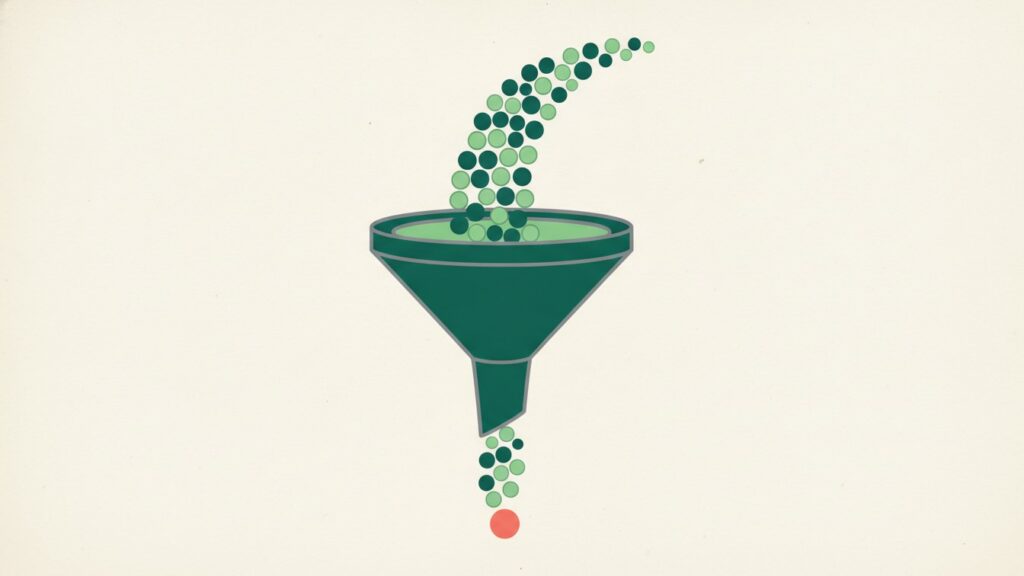
You pay exchange commission, the spread, deposit and withdrawal charges, and network fees. The spread is usually the largest and is almost never presented as a fee.
Key concepts
- The spread is a real cost and is rarely labelled as one
- Network fees depend on congestion, not on the amount sent
- Card deposits usually cost far more than bank transfers
- Failed transactions still cost gas
- Small transfers can be uneconomic during congestion
Crypto fees are unusually opaque, and the largest one is usually invisible. Here is the complete picture.
1. Exchange commission
The advertised trading fee, typically a percentage of the trade. Many platforms use a maker/taker model: adding liquidity with a limit order that rests on the book (maker) costs less than taking existing liquidity immediately (taker). Simply using a limit order can therefore reduce this fee.
2. The spread — usually the biggest
The spread is the gap between the best buy price and best sell price. Buy and immediately sell, and you lose that difference before any commission.
This is how “commission-free” platforms make money. A 2% spread on a purchase costs you 2%, whatever the advertised commission says. It is a real cost that simply is not itemised.
How to measure it: look at the buy and sell prices for the same asset at the same moment. That gap is your round-trip cost.
3. Deposit fees
Bank transfer is usually cheap or free but slower. Card deposits are instant and typically cost several percent — a meaningful bite out of a small first purchase. If you are not in a hurry, the bank transfer is almost always the better choice.
Watch for currency conversion too: depositing in one currency to trade in another can incur an exchange margin well above the interbank rate.
4. Withdrawal fees
Charged when moving crypto off the platform. Some exchanges pass through the actual network cost; others charge a fixed amount well above it and keep the difference. This is worth checking before you choose a platform, because it applies every time you self-custody.
5. Network fees
Paid to the blockchain itself, not to any company. Two properties surprise people:
They do not depend on the amount. Sending £10 and £10,000 can cost the same, because the fee prices block space, not value. This makes small transfers disproportionately expensive.
They vary with congestion. On Ethereum, gas is an auction: when demand is high, fees rise sharply within minutes. The same transaction can cost pennies or a great deal more depending on when you send it.
A third point that catches people out: a failed transaction still costs gas. The network did the work before the failure, so you can pay and receive nothing — for instance when a swap reverts because of slippage.
6. Costs that are not fees
- Slippage. Getting a worse price than quoted because your order moved the market. Real money, no line item.
- Conversion margins. The rate applied when your currency is converted.
- Tax events. In many jurisdictions each disposal is taxable — see how crypto is taxed.
Reducing what you pay
- Use bank transfer rather than card for deposits.
- Use limit orders where available — better price control and often a lower fee tier.
- Batch withdrawals rather than moving small amounts repeatedly.
- Check network conditions before transferring; fees fall considerably at quieter times.
- Compare platforms on round-trip cost, not advertised commission.
What to read next
Sources
Not financial advice
This article is educational and general in nature. Crypto is volatile and high-risk, and you can lose the whole of any amount you put in. Nothing here is a recommendation to buy, sell or hold any asset. Always do your own research and consider speaking to a qualified, regulated adviser in your country.
Keep reading

Guides & Tutorials
Impermanent loss explained, with numbers
A worked example of what happens to a liquidity position when prices diverge, why the name is misleading, and when fees actually…

Guides & Tutorials
How to read on-chain data
The public metrics worth checking before trusting a claim about a project — holder concentration, real activity, liquidity depth — and how…

Blockchain & Technology
How to check a smart contract before you interact
Practical checks a non-developer can make before approving a transaction — verification status, privileged functions, approval scope and revocation.
Join the discussion
Comments are open to members. An account is free and takes an email address and a password — nothing else.
Join free Sign in